
Heads up, because I promised you honesty always: this post contains affiliate links. If you buy through them, I may earn a commission at no extra cost to you. It doesn’t change what I recommend, and you’ll notice this is the only post on this site that asks you to consider buying anything at all.
If you’re like me, you did everything in the right order. You waited out the shedding. You ran the self-check. You sat in the paper gown while a dermatologist looked at your part through a little scope and said the words “pattern hair loss.” And then she mentioned minoxidil, and you said the sentence so many of us say: “I’m nursing,” or its sibling, “we’re planning another one.”
And the room got quiet, because most of the standard playbook has an asterisk for us.
This is the post about the lane that doesn’t. But first, the gate I will never stop putting in front of this content:
Read this part first: who this is NOT for
If you’re in the normal postpartum shedding window, this post is not for you, and neither is any product. Shedding that started around month three and is tapering resolves on its own. Devices like the ones below are not cleared for postpartum shedding, they are not a treatment for it, and buying one to “help” a temporary shed is spending real money on a problem that time fixes for free. Go read the shedding guide, and I mean this with love: close this tab.
This post is for one specific reader: you have confirmed pattern hair loss (androgenetic alopecia) in the early-to-mid range, ideally diagnosed by a dermatologist, and the drug options carry asterisks you’re not willing to accept right now. If you haven’t confirmed what you have, start with the never-came-back guide and the pattern loss explainer, then come back. Confirm first, choose second. House rules.
What red-light laser therapy actually is
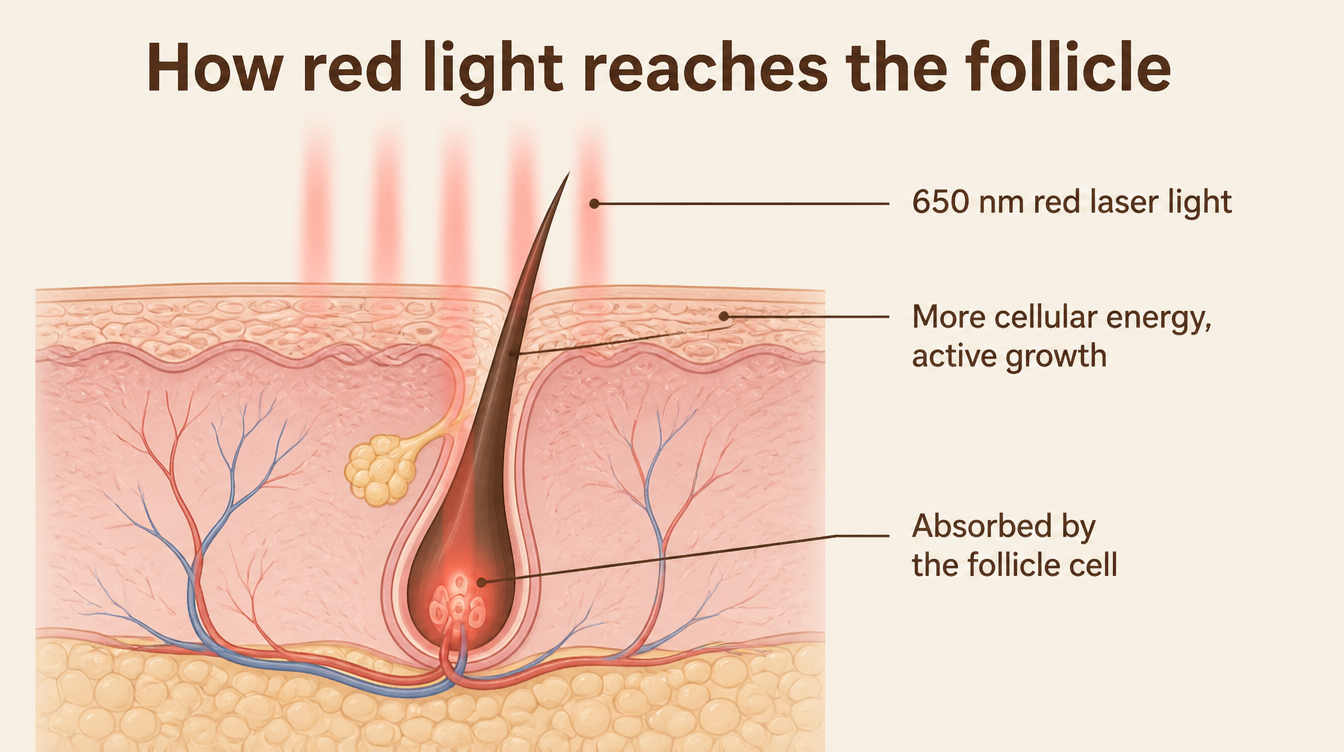
The clinical name is low-level laser therapy, or photobiomodulation if you want to win a spelling bee. The idea: red laser light at around 650 nanometers penetrates the scalp and is absorbed by the energy-producing machinery inside your follicle cells (the mitochondria, specifically an enzyme called cytochrome c oxidase, for my fellow overreaders). That absorption boosts the cell’s energy production, and better-fueled follicles are more likely to shift out of their resting slump and back into active growth.
Remember the photocopy metaphor from the explainer? Pattern loss is follicles gradually running out of steam and printing fainter copies. This therapy is, essentially, plugging the printer into a better outlet. It doesn’t change your genetics or your hormones. It supports the struggling follicle directly, from the outside, with light.
And that “from the outside” part is the entire reason this lane matters for us: nothing enters your bloodstream. No systemic absorption means no milk-supply questions, no pregnancy-category letters, no washout period before trying for baby number two. It’s the one clinically studied option where “I’m nursing” doesn’t change the conversation.
The evidence, stated like an adult
Here’s my honest read after far too many evenings on this.
The good: this isn’t fringe. Laser devices for pattern hair loss have been through actual clinical trials showing increased hair counts versus sham devices, and the legitimate ones are FDA-cleared for female pattern hair loss specifically, in the Ludwig stages covered in the explainer (roughly Stage I through II, plus the frontal pattern, in lighter skin tones, Fitzpatrick types I to IV, because the light has to reach the follicle rather than being absorbed by melanin along the way).
The honest asterisks: “FDA-cleared” means the FDA reviewed the device for its specific use; it’s the device pathway, not the same as drug approval, and I’d side-eye any brand that blurs that. Results take several months to show, because hair only changes at the speed of the hair cycle. Some women respond better than others, and earlier stages respond best. And this is a relationship, not a cure: consistency is everything, and if you stop entirely, the benefit can fade back the way it came.
The realistic expectation: not Rapunzel. What the evidence supports is thicker regrowth in the thinning zone, a part that stops widening and starts modestly closing, and hairs that print darker copies again. If a brand promises more than that, they’re selling to your fear, not your follicles.
How to not get ripped off in this category
Because this category is a magnet for junk, here’s the checklist I built before spending anything:
- Real lasers, not LEDs. The clinical evidence is built on laser diodes. Plenty of cheap caps pad their numbers with LEDs, which are dimmer, unfocused, and cheaper for a reason. Ask what the diode count is and what kind of diodes they are.
- FDA clearance you can verify, for female pattern hair loss specifically, not just “registered” (which means almost nothing) and not cleared only for men.
- Diode count and coverage. More laser diodes means more of your scalp treated per session. For us, coverage across the part line and crown, where Ludwig-pattern thinning lives, is what matters.
- A protocol you’ll actually do. This one is underrated. Some devices demand 25 to 30 minutes every other day. Be honest about whether you have that. A treatment you skip doesn’t work.
- One-time purchase. No subscriptions, no consumables, no app paywall attached to your scalp.
What I chose: the Xtrallux line
After running everything through that checklist, I went with Xtrallux, and I want to walk you through exactly why, including the cons, because that’s the deal here.
Why it won my spreadsheet: the caps use real laser diodes only (no LED padding), they run continuous light rather than pulsed (steadier light delivery to the follicle per minute of wearing it), they’re FDA-cleared, it’s a one-time purchase, and, the thing that genuinely decided it for me: the protocol is 6 minutes, once a day. Not thirty. Six. It’s a dome that sits inside a regular ball cap, it runs on a small battery pack, and it beeps when it’s done. I do it while feeding Nora her breakfast. If you’ve ever wondered what treatment adherence looks like for a mother of a toddler, it looks like six hands-free minutes, and essentially nothing else.
The lineup, plainly:
- Alpha: 136 laser diodes, 12-month device warranty. The entry point; least coverage per session.
- Super Plus: 276 diodes, 24-month warranty. The sensible middle, and where I’d point most Stage I readers. Roughly double the Alpha’s coverage.
- Turbo Pro: 316 diodes, 36-month warranty. The one I use. More coverage across the crown and part zone and a longer warranty, which matters for a device you’ll use daily for years.
- Extreme RX: 352 diodes, 60-month warranty. The maximalist option, and the only one you can’t just add to a cart: it’s sold through Xtrallux’s provider network rather than direct to consumers. More than most early-stage readers need anyway.
The honest cons, because there are always cons: it is not cheap, and I won’t pretend otherwise; this is a considered purchase, not an add-to-cart. Results take months, during which you may even notice a brief uptick in shedding as sluggish old hairs make way for new growth (normal, documented, still unnerving). You have to actually do it every day, indefinitely, and skipping weeks quietly refunds your progress. My petty cons: the battery pack wants charging more often than I remember to charge it, and there is no version of laser-dome hair that survives the six minutes unflattened, so I do it before styling, not after.
The fine print that matters: these devices are for pattern hair loss only. Not for shedding or effluviums of any kind, not for patchy loss like alopecia areata, not for scarring types, not for advanced loss, and not cleared for deeper skin tones (Fitzpatrick V to VI). If you take any medication that increases light sensitivity, that’s a conversation with your doctor before anything else. And truly: if you’re unsure which category you’re in, that’s your sign the derm appointment comes first. The device will still exist afterward.

If you do this, do it like this
Take baseline photos before the first session, same spot, same light, and repeat monthly; hair changes too slowly for memory to be trusted, and photos are how you’ll actually know whether it’s working for you: How to Take Hair Progress Photos That Don’t Lie. Commit to the daily six minutes the way you’d commit to a prescription, anchored to something you already do every day. Judge nothing before several months in. And keep your dermatologist in the loop; this pairs fine with fixing iron or thyroid issues, and a follow-up visit with your photos is worth more than any before-and-after a brand shows you.
The short version, one-handed edition
- This is only for confirmed pattern hair loss, early-to-mid stage. Postpartum shedding needs nothing but time; buying a device for it wastes your money.
- Red-light laser therapy supports struggling follicles from outside the body: no bloodstream, no nursing or pregnancy asterisk. That’s its superpower for us.
- It’s clinically studied and FDA-cleared for female pattern loss, and it’s a months-long, consistency-dependent commitment with realistic (not miraculous) results.
- Buy smart: real laser diodes, verifiable clearance for women, high diode count, a protocol you’ll keep, one-time payment.
- I chose Xtrallux for the 6-minutes-a-day protocol, laser-only design, and warranty range; Super Plus is the sensible pick, Turbo Pro is mine.
Whatever you decide, decide it from a diagnosis and a plan, not from 2 a.m. fear. You’ve done this whole journey the careful way. Finish it the same way.
You’re still in there. — Kelsey
Leave a Reply