If you’re like me, you got here by way of a widening part, a family photo, and the slow realization that the “it’s just postpartum shedding” explanation stopped fitting a while ago.
Maybe you ran through the self-check and answered yes more than you wanted to. Maybe a dermatologist already said the words “female pattern hair loss” and handed you a pamphlet that explained nothing. Either way, you deserve a real explanation, the kind a friend who did all the reading would give you over coffee while the kids destroy the living room.
So here it is: what pattern hair loss actually is, what the Ludwig scale means, what a dermatologist is actually looking for, and an honest map of the options. No panic and no pitch.
What female pattern hair loss actually is
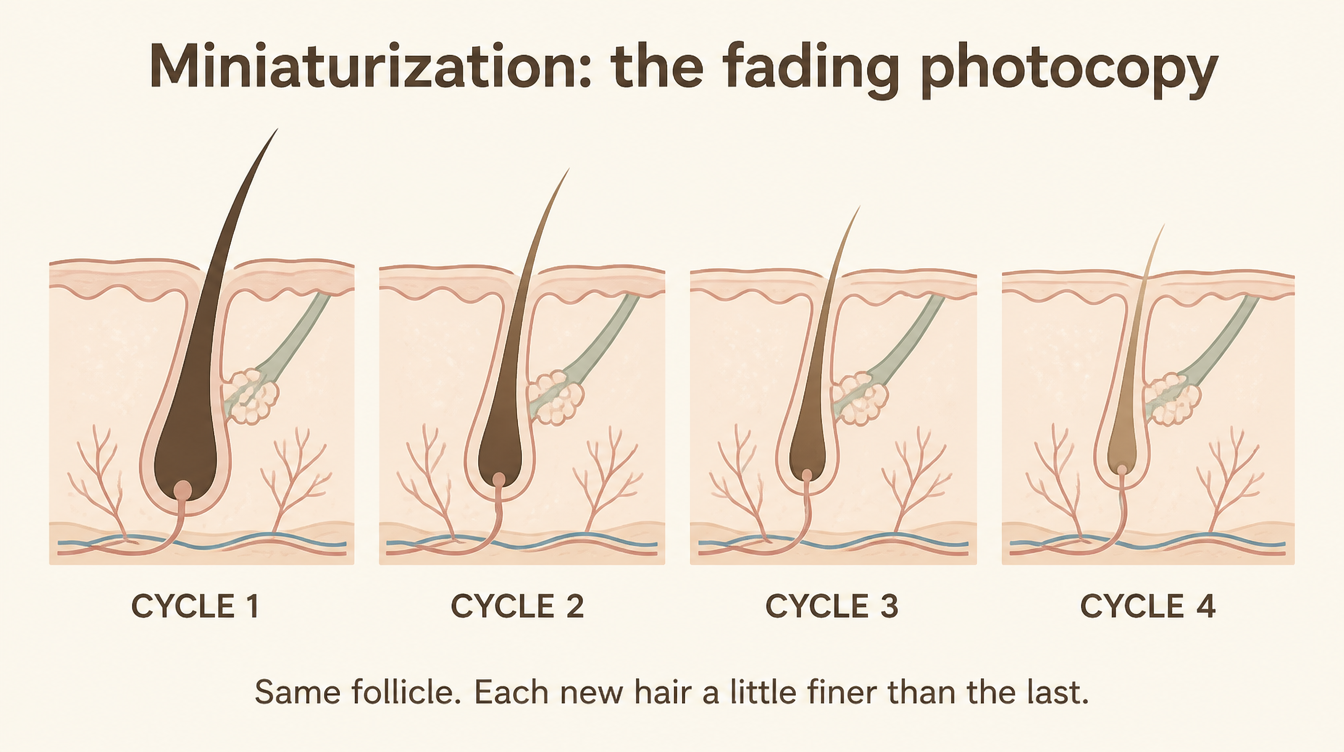
The medical name is androgenetic alopecia, and the short version is this: some follicles are born with a genetic sensitivity to a hormone byproduct called DHT. Over years, DHT gradually shrinks those sensitive follicles in a process called miniaturization.
Here’s the part that made it click for me. The follicles don’t die and the hairs don’t just fall out. Each shrinking follicle keeps producing hair, but every new hair it grows comes in a little finer, a little shorter, a little lighter than the one before. Like a photocopy of a photocopy. Ten thousand slightly-fainter photocopies across your part is what “thinning” actually is: the same number of follicles making progressively wispier hair.
Three things follow from that, and they matter:
- It’s genetic, not something you caused. Not the postpartum shed, not stress, not your ponytail, not nursing. Pregnancy didn’t create it; the shed just cleared enough hair to make an existing slow process visible. It can come from either parent’s side.
- It’s gradual. This process is measured in years, not weeks. Whatever you decide to do, you are not racing a clock that expires next month.
- Miniaturized is not dead. A shrinking follicle is a struggling one, not a gone one, which is exactly why treatments exist at all, and why acting earlier beats acting later: it’s easier to support a follicle that’s shrinking than to revive one that’s been dormant for a decade.
The Ludwig scale, translated from doctor
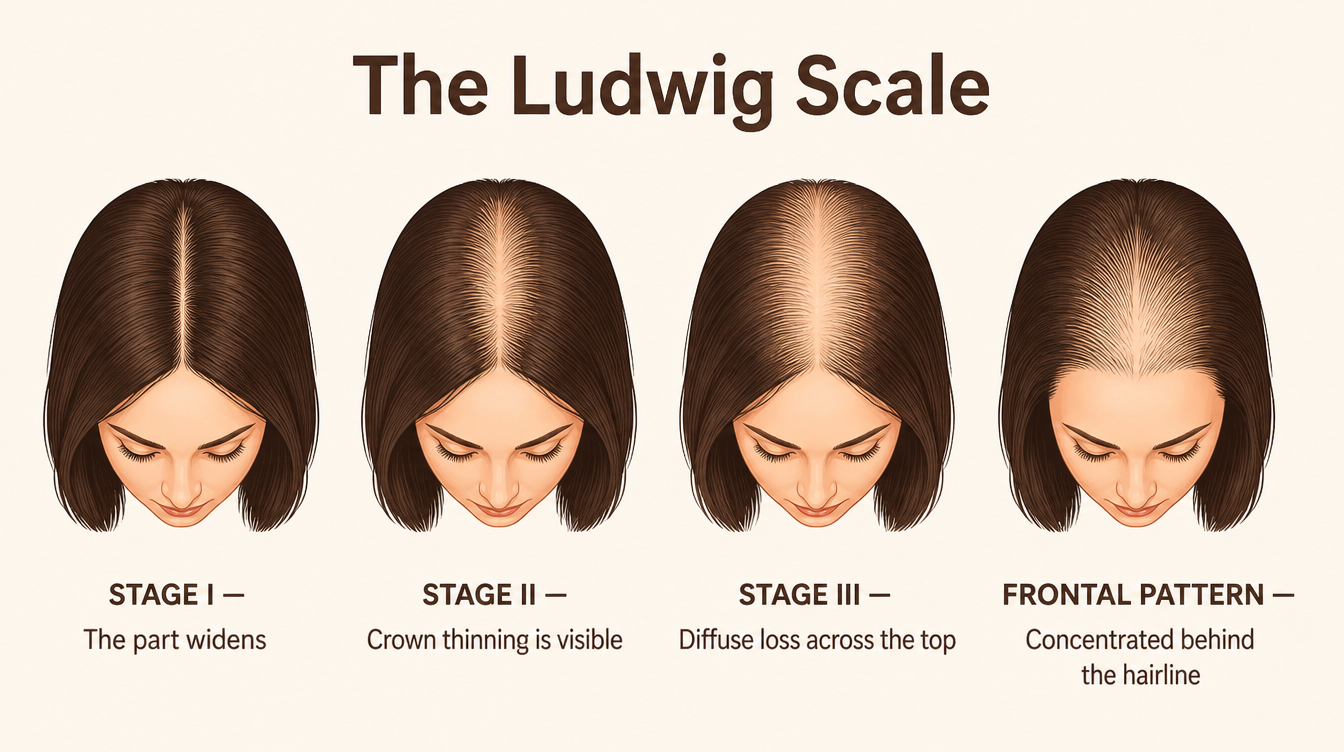
Dermatologists grade female pattern loss on the Ludwig scale (sometimes called Ludwig-Savin). It sounds intimidating and it’s actually just a description of where you are on a slow road:
- Stage I (I-1 through I-4): the part widens. Thinning is centered on the top of the head, mild to noticeable, but easily hidden with styling. The hairline at your forehead mostly holds. Most women who arrive via the postpartum route are somewhere in Stage I.
- Stage II (II-1, II-2): the widening becomes a visible zone. More scalp shows at the crown and along the part; the ponytail is clearly thinner; overhead lighting becomes your enemy.
- Stage III: advanced, diffuse thinning across the top with significant scalp visibility.
- Frontal pattern: a variant where the thinning concentrates just behind the front hairline in a sort of Christmas-tree shape when the hair is parted.
Why bother learning your stage? Because it’s the single most useful piece of information for choosing what to do. Nearly all the well-studied treatments (drug and drug-free alike) were tested and cleared for early-to-mid stages, roughly Ludwig I through II. That’s not marketing fine print; it’s about biology. Those are the stages where follicles are still alive enough to respond. It’s one more reason “wait and see for another few years” is the one strategy with no upside.
What the dermatologist is actually looking for
If you’ve read my guide to the derm visit, you know the exam is short and painless. Here’s what’s happening in their head during it:
- Variety of hair thickness. Under the dermatoscope, pattern loss has a signature: hairs of many different diameters in the same small area, thick old survivors next to fine miniaturized ones next to wispy in-betweeners. Shedding doesn’t produce that mix; miniaturization does. This one finding does most of the diagnostic work.
- The front-to-back comparison. They’ll compare density at your part and crown against the back of your head, which is genetically protected territory in pattern loss. Thin on top, normal in back is the pattern; thin everywhere equally points back toward shedding or something systemic.
- Your story. Family history, when the part started widening relative to pregnancy, and bloodwork to rule out the impostors (iron, thyroid) that can mimic or worsen thinning.
Walk out with a stage and a confirmed diagnosis, and you’ve converted a year of mirror anxiety into an actual decision point.
The honest map of your options
I’m going to give you the landscape the way I’d want it given to me, in categories, with the trade-offs stated plainly. This is a map, not a prescription; the full deep-dive on the choices that fit our particular season of life is its own article.
The drugs. Topical minoxidil is the most-studied treatment in existence for this and the usual first thing a derm mentions; it works for a lot of women, requires indefinite daily use, and comes with a real conversation to have with your doctor if you’re nursing or planning another pregnancy. Prescription options like spironolactone work on the hormone side and are firmly off the table during pregnancy. Neither of these is a villain. They’re just drugs, with drug trade-offs, at a time when many of us are specifically trying to keep our bodies drug-free for someone else’s sake.
The drug-free, clinically studied lane. This mostly means red-light laser therapy (the clinical name is low-level laser therapy), where light-emitting devices worn on the scalp stimulate the energy production of struggling follicles. The legitimate versions are FDA-cleared specifically for female pattern hair loss in the Ludwig stages we just covered, they’re studied in actual trials, and because nothing enters your bloodstream, they don’t carry the nursing-and-pregnancy asterisk the drugs do. That combination is why this lane matters so much for this audience specifically, and it’s exactly what the next guide in this series covers properly, including what the evidence really shows and how to not get ripped off, because this category attracts junk imitators: Drug-Free Options for Pattern Thinning When You’re Nursing or Planning Baby #2.
The supportive cast. Fixing low iron or thyroid issues if bloodwork found them (sometimes a dramatic difference on its own), volumizing haircuts and styling, and for later stages, toppers and cosmetic options that are nobody’s business but yours.
The one non-option. Doing nothing while hoping it reverses. Pattern loss is progressive; it moves slowly, but it only moves one direction on its own. Even “I’ll decide in six months” is a fine plan. “It’ll probably fix itself” is the only plan the biology doesn’t support.
The short version, one-handed edition
- Female pattern hair loss is genetic follicle-shrinking, not hair falling out: each new hair grows back slightly finer, like fading photocopies.
- You didn’t cause it, pregnancy just unmasked it, and it moves slowly. You have time to decide well.
- The Ludwig scale (Stage I: widening part, Stage II: visible crown thinning) tells you what’s proven for your stage. Early stages have the most options.
- The derm confirms it by spotting mixed hair thicknesses under magnification and comparing top-of-head to back-of-head density.
- Options: minoxidil and prescription drugs (effective, with nursing/pregnancy caveats), FDA-cleared red-light laser therapy (drug-free lane, next article), fixing bloodwork issues, and smart styling. The only bad plan is assuming it reverses on its own.
A diagnosis with a name and a stage isn’t the moment your hair story ends. It’s the moment you stop fighting a fog and start dealing with a known, slow, manageable thing, with real options and no deadline panic.
You’re still in there. — Kelsey
Leave a Reply