If you’re like me, your camera roll is 9,000 photos of your child and four blurry, panicked photos of your own scalp, taken in different bathrooms, in different lighting, with your hair parted differently every time.
Which means you have zero usable information. Hair changes at about half an inch a month; no memory on earth can track that, and random panic photos can’t either. Whether you’re waiting out shedding, watching a part you’re worried about, or actually treating pattern thinning, the single most useful free tool you have is a boring, repeatable monthly photo.
Here’s the system I use. It takes four minutes a month, and it’s designed around one principle: a progress photo is only worth something if the only variable is your hair.
Why photos beat feelings
Two reasons. First, hair anxiety is a liar in both directions: on a bad-lighting day you’ll swear you’ve lost half your hair, and slow real change can hide in plain sight for a year. Second, if you ever do treat pattern thinning, the honest answer to “is this working?” takes months to appear, and it appears in millimeters of part width, not in moments of feeling. Photos are how you catch it. They’re also gold at a dermatologist appointment; a dated photo series does more in fifteen minutes than any description you can give.
The setup: same, same, same, same
Pick these once, then never change them:
- Same spot. One bathroom, one place to stand, marked in your head (“toes at the bath mat edge”). The mirror matters less than the consistency.
- Same light. This is the big one. Overhead bathroom light, always, or window light at the same time of day, always. Light from above shows the part and crown honestly; changing the light changes the “results” more than any treatment ever will.
- Same hair state. Dry, unstyled, no product, parted in your normal part with the same comb. Wet hair clumps and shows scalp dramatically; a photo of wet hair next to a photo of dry hair is a lie in both directions.
- Same day-ish. First Sunday of the month, or baby’s monthly birthday, whatever you’ll remember. Set a recurring phone reminder titled something kind.
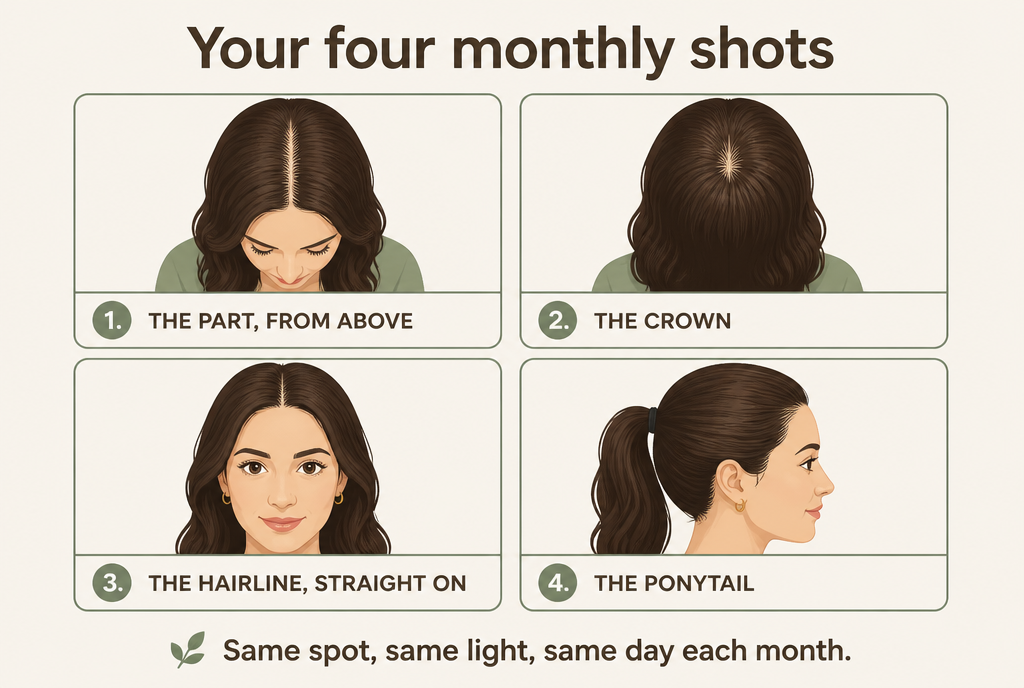
The four shots
1. The part, from above. Head tilted forward, phone held above and slightly in front, shooting down the line of your part. This is the money shot for pattern watching, since part width is where change shows first. If a helper exists (Ben has been drafted into scalp photography and has made peace with it), let them take it; if not, a selfie-mode shot with your chin tucked works.
2. The crown. Back of the head, top-down angle. Solo method: stand with your back to the big mirror, hold the phone facing the mirror over your shoulder, take five, keep the sharpest one. It will feel ridiculous. Do it anyway; the crown is the other place pattern change lives, and it’s the spot you literally cannot see day to day.
3. The hairline, straight on. Face the mirror, hair pushed back the same way each time. This is where you’ll watch the baby-hair halo fill in after shedding, which is deeply satisfying to scroll through later.
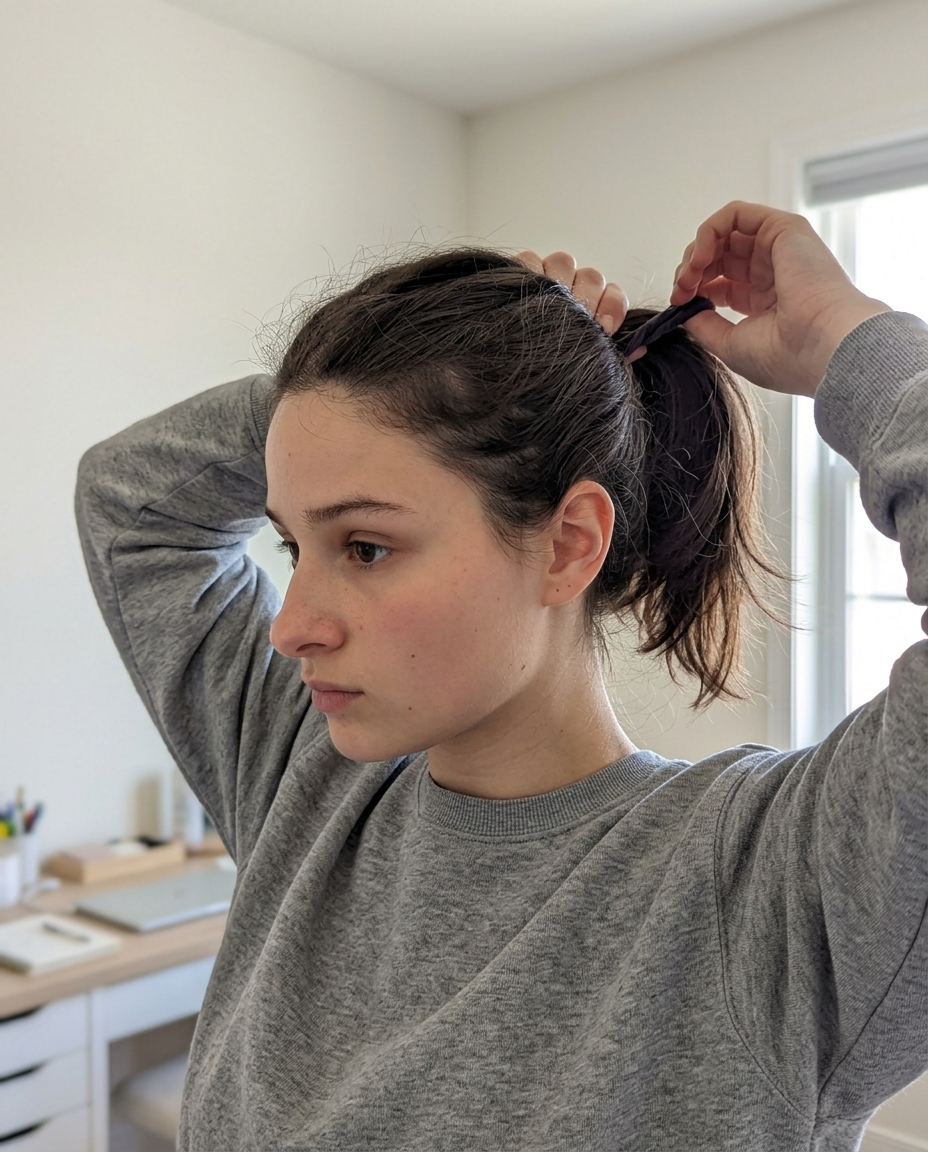
4. The ponytail. Same elastic every month, wrapped snug, photographed from the side. Then log the wrap count in the caption or a note: “Elastic wraps: 3.” The hair tie is the cheapest densitometer ever invented, and the wrap count turns “I feel like it’s thinner” into an actual number moving one direction or the other.
Ten photos total if you take a couple of each, four keepers, one monthly album. Name the album something that doesn’t make you sad when you see it. Mine is just “Hair, monthly.”
How to read them without gaslighting yourself
Compare across months, never within a day. The only fair comparison is this month’s part shot against the same shot from one, three, six months ago. Side by side, same light. Most phones let you favorite the keepers so they line up in one swipe.
Expect noise. Hair density genuinely fluctuates a little; one slightly-worse month means nothing. Three consecutive months moving the same direction is a trend. This cuts both ways: it protects you from panic and from false hope equally.
Know what “better” looks like on a realistic timeline. If you’re recovering from shedding, better looks like the halo filling the temples over months. If you’re treating pattern thinning, better looks like the part narrowing by amounts you’d never notice without the photos, on the several-months timeline covered in the treatment guide. Nothing legitimate changes hair in three weeks, so a photo series that “proves” anything that fast is measuring lighting, not follicles.
And know what “worse” is for. If your series shows a part that keeps widening month over month, that’s not a failed photo project. That’s the earliest, calmest possible version of catching pattern thinning, exactly the situation covered in the never-came-back guide, and your photo series just became the best thing you could possibly bring to a derm appointment. The photos didn’t create the problem. They handed you a two-year head start on it.
The short version, one-handed edition
- Hair changes too slowly for memory. A boring monthly photo is the only honest tracker.
- Lock the variables: same spot, same overhead light, same dry unstyled hair, same day each month.
- Four shots: part from above, crown, hairline, and the ponytail with an elastic wrap count.
- Judge trends across three-plus months, never single photos. Fast dramatic “change” is almost always lighting.
- A worsening series isn’t failure; it’s early information, and it makes your derm visit ten times more useful.
You photograph everything that grows around here. This is just adding one more thing to the list, and this one grows back for you.
You’re still in there. — Kelsey
Leave a Reply