If you’re like me, you gave it the full year.
You read the reassuring posts (maybe even mine). You waited out the shedding. You watched the baby-hair halo come in and told yourself it was all going back to normal. And then your baby turned one, and you looked in the mirror, and your part is still wider than it used to be. The ponytail is still skinny. The “wait it out” advice everyone gave you has officially run out of runway.
First: I believe you. This is the post for the women the reassuring posts leave behind.
Second, and I want to say this before anything else: this is still a solvable situation. But it’s a different situation than shedding, and it deserves a straight answer instead of another round of “just give it time.”
Why “wait it out” stopped being the right advice
Postpartum shedding (the technical name is telogen effluvium) is an event. It has a beginning, a peak, and an end, usually all inside the first year. I wrote a whole guide to that timeline here: Why Is My Hair Falling Out After the Baby?
If your density came back by the first birthday, that post is your whole story. Close this tab. Buy nothing. Go live your life.
But if it’s been 12 months or more and your hair never recovered, one of a few different things is probably going on, and none of them are “you just need more patience.”
The three most likely explanations
1. Something in your bloodwork is dragging recovery out.
Low iron (very common after pregnancy, especially if you had a heavy delivery or you’re nursing), thyroid issues (postpartum thyroiditis affects a meaningful chunk of new moms and often goes undiagnosed), or general depletion can all keep hair stuck in low gear. The good news: these are findable with a basic blood panel and fixable. This is one big reason a doctor visit beats another year of guessing, and I wrote about exactly what that visit looks like here: When to Actually See a Dermatologist About Your Hair.
2. The shedding is still smoldering.
In a smaller group of women, effluvium drags on past the normal window, sometimes because of ongoing stress, sleep deprivation (hello), nutrition, or a second pregnancy resetting the clock. This still tends to resolve, but past the one-year mark it’s worth confirming rather than assuming.
3. The shedding pulled back the curtain on pattern thinning.
This is the one nobody warns us about, so let’s talk about it like adults.
What pattern thinning actually is (and isn’t)
Female pattern hair loss is genetic. It runs in families, it develops gradually, and for a lot of women it was quietly starting before pregnancy ever happened. The postpartum shed didn’t cause it. It just removed enough hair at once that the pattern underneath became visible for the first time.
The key word is pattern. Unlike shedding, which happens everywhere at once, pattern thinning has an address:
- The center part that keeps getting wider, month over month, year over year
- More scalp visible at the crown, especially in overhead light or photos taken from behind (the most hostile camera angle known to womankind)
- A ponytail that’s noticeably thinner than it was two or three years ago
- The hairline itself usually holds; it’s the part and crown that give it away
Dermatologists grade it on something called the Ludwig scale, which I break down properly in its own post: Female Pattern Hair Loss, Explained Like a Friend Would. For now, the honest self-check is simpler.
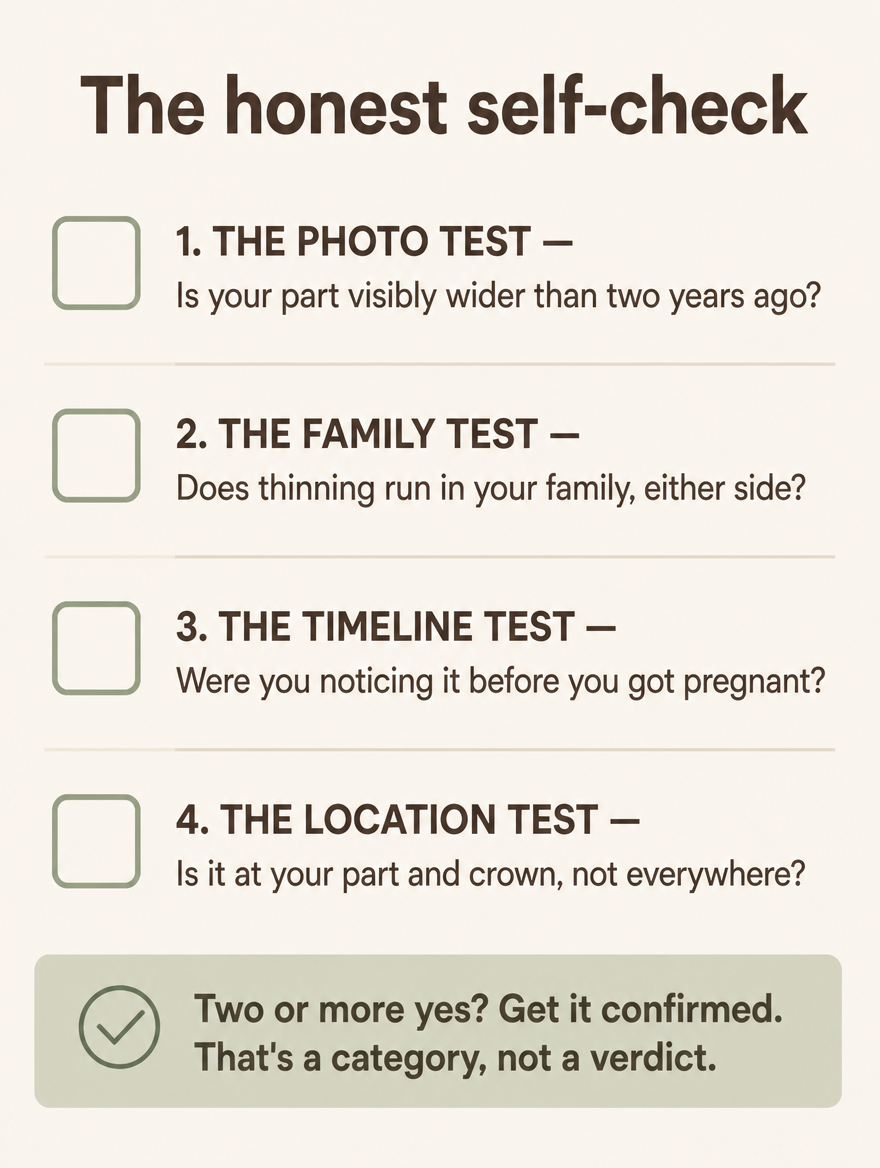
The honest self-check
Grab your phone and answer these for yourself. Nobody’s watching.
- The photo test. Find a photo of your part from two or three years before pregnancy (vacation photos and old selfies are gold). Compare it to your part today, same lighting if you can. Is today’s part visibly wider?
- The family test. Does your mom, either grandmother, an aunt, or a sister have visible thinning at the part or crown? It can come from either side of the family.
- The timeline test. Were you already noticing a skinnier ponytail or a wider part before you got pregnant, even if you brushed it off at the time?
- The location test. Is the change concentrated at your part and crown, rather than spread evenly everywhere?
Mostly no’s? You’re probably in camp 1 or 2 above: get the bloodwork, fix what it finds, and give it a properly supported few months.
Two or more yes’s? Then pattern thinning is a real possibility, and here’s the part I need you to hear: that is not a verdict, it’s a category. It just means the right next steps are different ones.
What I want you to do next (and not do)
Do: get it confirmed. A dermatologist can usually distinguish lingering effluvium from pattern thinning in one visit, with a scalp exam and some bloodwork. Walk in with your photo comparison and your family history and you’ll make their job easy. Here’s exactly what that appointment looks like and what to ask.
Do: start taking consistent photos of your part and crown now, same spot, same light, once a month. Whatever happens next, you’ll want a real baseline instead of a feeling.
Don’t: panic-buy. The internet will now show you forty products, and most of them are the same overpriced nothing I warned you about in the shedding post. Pattern thinning does have legitimately proven options, including ones compatible with nursing and future pregnancies, and I cover them properly, starting with understanding your pattern: Female Pattern Hair Loss, Explained Like a Friend Would. But the order of operations matters: confirm first, then choose. Not the other way around.
Don’t: spiral. Pattern thinning is slow. Nothing about your hair will meaningfully change between now and a derm appointment three weeks out. You have time to do this right.
The short version, one-handed edition
- If your hair recovered by the first birthday: normal shedding, story over, buy nothing.
- If it didn’t: it’s most likely bloodwork (iron, thyroid), a dragged-out shed, or genetic pattern thinning that pregnancy unmasked.
- Pattern thinning has an address: widening part, thinner crown and ponytail, family history, often starting pre-pregnancy.
- Two or more yes’s on the self-check = get it confirmed by a dermatologist. That’s a category, not a verdict.
- Confirm first. Choose second. Panic never.
A year of waiting for hair that didn’t come back can make you feel like you got left out of your own happy ending. You didn’t. Your story just has one more chapter than the shower-drain posts promised, and you’re allowed to want real answers for it.
You’re still in there. — Kelsey
Leave a Reply