
If you’re like me, it started in the shower.
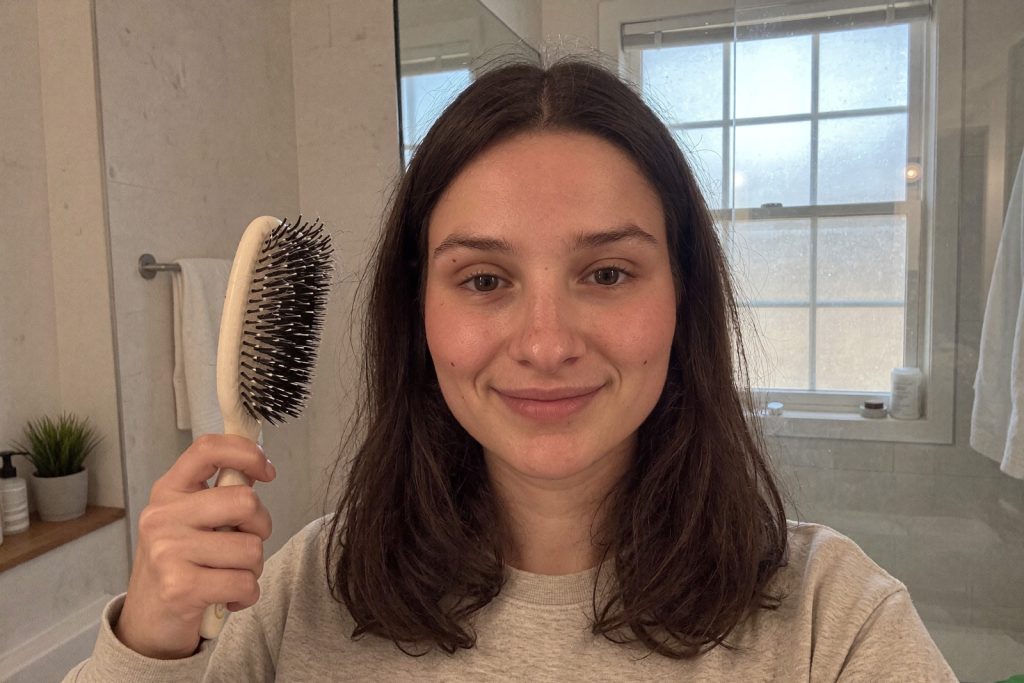
Nora was about three and a half months old. I pulled my fingers through my wet hair and came away with what I can only describe as a small woodland creature. I did the thing we all do: held it up, stared at it, and quietly googled “how much hair loss is normal” with one hand while holding a baby with the other.
So let me tell you what I wish someone had told me that day, before we get into any of it:
This is almost certainly temporary. You are not going bald. And you do not need to buy anything.
Now let’s actually understand what’s happening, because the not-knowing is honestly the worst part.
What postpartum shedding actually is
The official name is postpartum telogen effluvium, which sounds terrifying and is not.
Here’s the short version. Every hair on your head cycles between a growing phase (anagen) and a resting phase (telogen). Normally about 85 to 90 percent of your hair is growing at any given time, and the resting hairs quietly shed at a rate of 50 to 100 a day. You never notice.
Then you got pregnant, and estrogen did you a favor: it held your hairs in the growing phase longer than usual. That’s why so many of us had genuinely great hair in the second and third trimester. It wasn’t a glow. It was a backlog.
After delivery, estrogen drops fast, and all those overdue hairs shift into the resting phase at once. A few months later, they let go. Together. Dramatically. In your shower drain, your hairbrush, your baby’s fist.
You’re not losing extra hair. You’re losing months of hair that stuck around past its checkout time, all in one wave.
The timeline nobody gave you
This is the part I taped to the inside of my brain:
- Months 0 to 2: usually nothing yet. Enjoy the calm.
- Months 3 to 4: the shedding starts. This timing is so consistent it’s almost rude.
- Months 4 to 6: the peak. This is woodland-creature territory. It can feel alarming and it is still normal.
- Months 6 to 12: it slows down, then stops. New regrowth comes in as those short, fuzzy baby hairs that stick straight up along your hairline like a tiny halo. Mine made me look permanently staticky. They are a good sign, even when they are an annoying one.
- By your baby’s first birthday: for most of us, hair density is back to something that feels like yours.
Dermatologists, including the American Academy of Dermatology, describe exactly this arc: shedding that begins a few months after delivery and resolves on its own, with fullness typically returning around the one-year mark. No treatment required. The fix is time, which is the one thing nobody wants to hear and the only thing that’s true.
What actually helps (an honest list)
Here’s where I’m supposed to sell you a miracle shampoo. I’m not going to, because there isn’t one. Nothing you put on your scalp can stop a hormonal shedding wave that was set in motion months ago.
What genuinely helps is smaller and less glamorous:
Be gentle with what’s there. Loose styles instead of tight ponytails, a soft brush, less heat. Not because tension causes the shedding, but because hair that’s shedding doesn’t need extra breakage on top.
Eat like a person who is recovering from building a human. Protein, iron, general nutrition. If you’re depleted (very common after pregnancy and while nursing), that can drag hair recovery out. Your postnatal vitamin is fine. You don’t need the $60 “hair recovery” supplement with the pastel label.
A shorter cut, if you want one. Purely cosmetic, totally optional. Less length makes shedding less visible and the regrowth halo blend in faster. Ben still refers to my postpartum bob as “the decision,” but honestly, it helped.
Patience. I know. I’m sorry. It’s the whole treatment.
That’s it. That’s the list. If a product promises to stop postpartum shedding, it is selling you a solution to a problem that resolves itself, and I need us all to keep our money.
When it’s not just shedding
Okay. This section is important, and it’s the reason I wanted to write this post first, before anything else on this site.
For most of us, this story ends at the first birthday with a full (if fuzzy) head of hair. But for some women, it doesn’t, and pretending otherwise wouldn’t be honest.
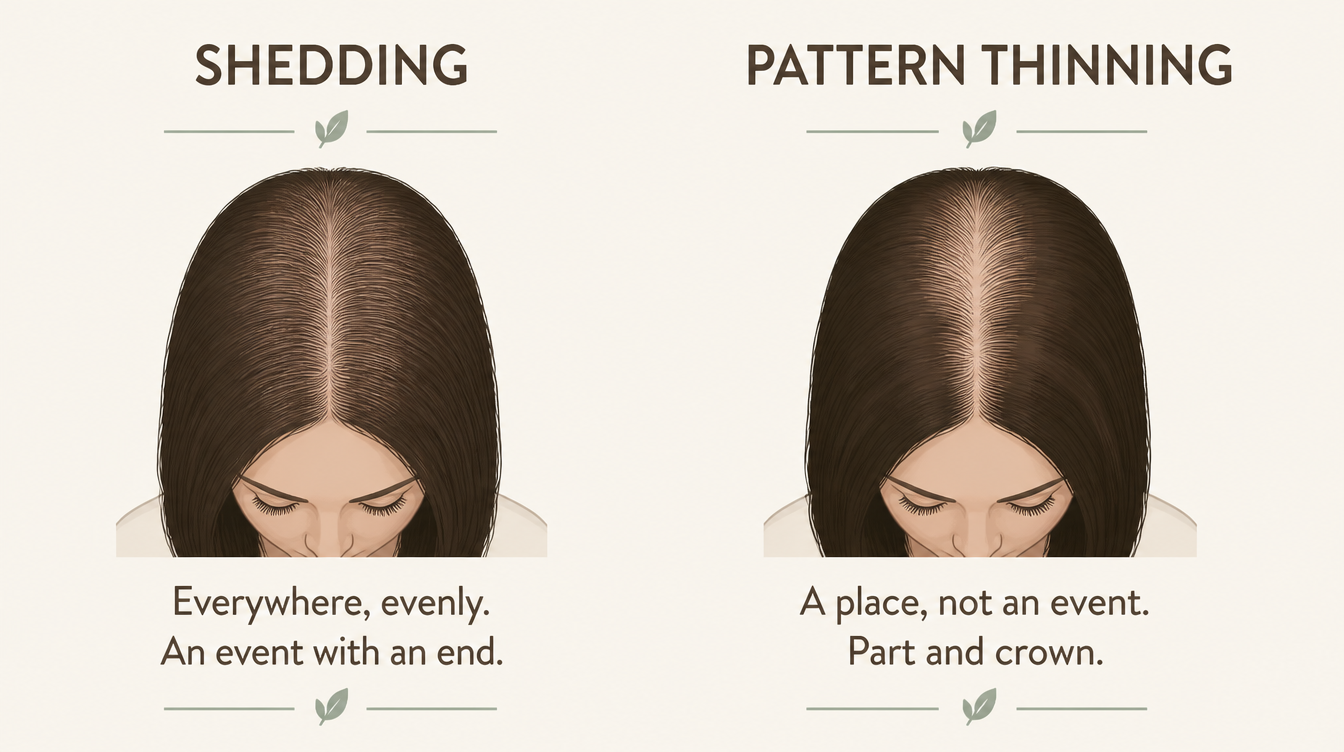
Postpartum shedding can sometimes unmask a different, unrelated thing: female pattern hair loss, which is genetic, gradual, and was often quietly starting before pregnancy ever happened. The shedding wave didn’t cause it. It just pulled back the curtain.
Here’s how to tell the difference, in plain terms:
- Shedding is hair coming out everywhere, evenly, starting around month three and clearly slowing by month six or so.
- Pattern thinning shows up as a place, not an event: a center part that keeps getting wider, more scalp showing at the crown, a ponytail that’s thinner than it was two years ago, not two months ago.
A few honest questions to ask yourself:
- Is it more than 12 months postpartum and your density never came back?
- Does your mom, grandmother, aunt, or sister have visible thinning?
- Were you already noticing a wider part or a skinnier ponytail before you got pregnant?
- Is the change concentrated at your part and crown rather than all over?
If you answered no to all of these: close this tab, you’re shedding, it ends, go take a nap if anyone will let you.
If you answered yes to a couple of them, that doesn’t mean panic. It means the “wait it out” advice in this post is the wrong advice for you, and you deserve the right information instead. I wrote a whole separate guide for exactly this situation: It’s Been a Year and My Hair Never Came Back. And a dermatologist can tell you definitively what’s going on, often in a single visit (here’s exactly what that visit looks like).
The one thing I won’t do on this site is blur that line. Temporary shedding and pattern thinning are different problems with different answers, and anyone who sells you one answer for both is not your friend.
The short version, for those of us reading one-handed at 3 a.m.
- Postpartum shedding is hormonal, extremely common, and temporary.
- It starts around month 3, peaks around months 4 to 6, and resolves by around month 12.
- Nothing you can buy will stop it. Gentle handling, decent nutrition, and time are the whole plan.
- The fuzzy baby-hair halo is regrowth. It’s a good sign wearing a bad haircut.
- If your density never comes back after a year, or thinning is concentrated at your part and runs in your family, that’s a different situation and there’s a real path for it. Start with this guide.
Your hair is on the floor, in the drain, and woven into every piece of clothing you own. But it’s coming back. And in the meantime, the person under that hair didn’t go anywhere.
You’re still in there. — Kelsey
Leave a Reply