If you’re like me, you didn’t want reassurance so much as you wanted a schedule.
When does this start? When is it worst? When does it stop? And the question underneath all of them: how do I know if mine is normal?
I’ve written the big-picture guide to why postpartum shedding happens. This post is the companion piece: the actual timeline, month by month, including the parts nobody mentions, like the second mini-shed that can hit when you wean, and what it means if your version doesn’t match the schedule.
Print it, screenshot it, tape it to the shower wall. Whatever helps.
First, why the weird 3-month delay?
This is the detail that made the whole thing click for me.
When a hair “decides” to shed, it doesn’t fall out that day. It enters a resting phase called telogen, and it sits there, still attached, for roughly three months before it finally lets go. Think of it as a notice period. The hair has quit; it just hasn’t left the building yet.
Your estrogen dropped in the days after delivery. That’s when thousands of hairs quietly handed in their notice, all at once. Three months later, their notice period ends together, and that’s the wave hitting your shower drain. The shedding you see in month four was actually decided in week one. Nothing you did in between caused it, and nothing you did in between could have stopped it.
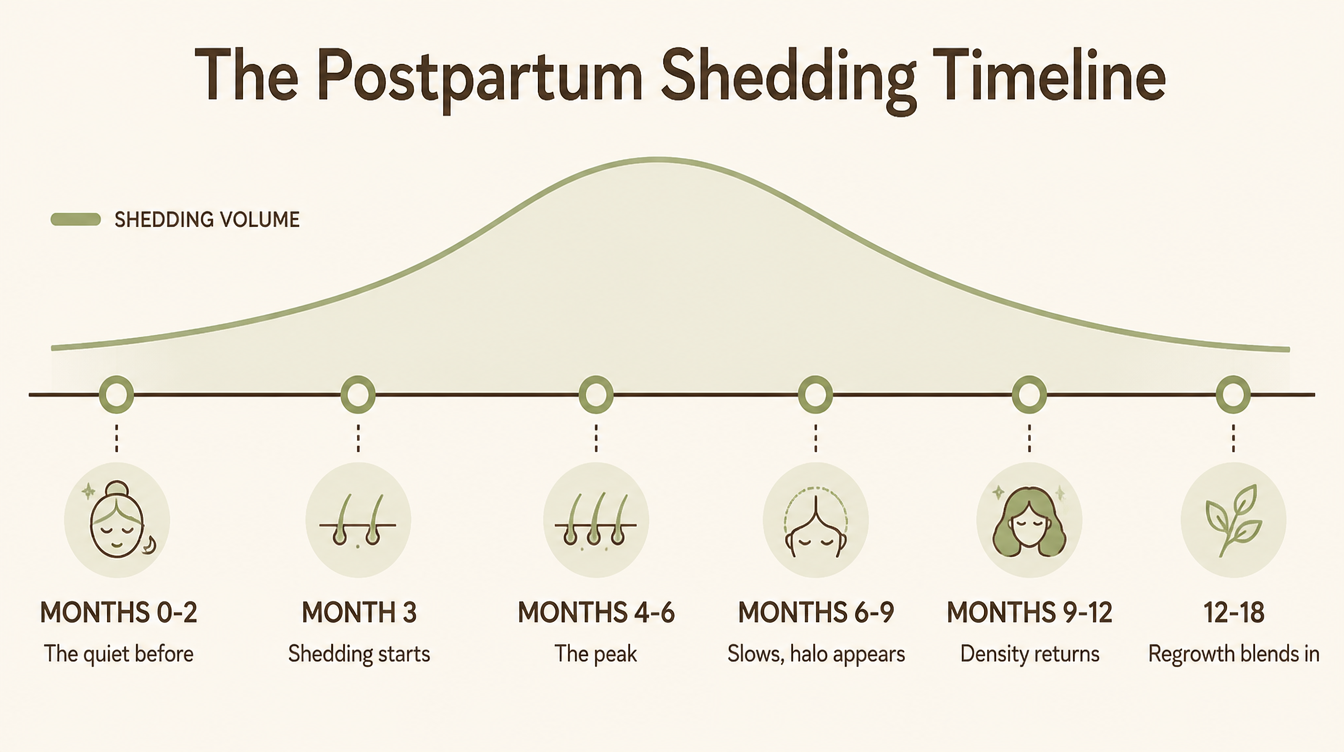
The timeline, month by month
Months 0 to 2: the quiet before. Hair often still looks like your pregnancy hair. Some of us even keep the extra fullness for a bit. If you’re reading this in month one with great hair, I’m sorry to be the bearer, but also: now you won’t be blindsided like I was.
Month 3: it begins. Usually somewhere between weeks 10 and 14. The first sign is often the shower drain, or a hairbrush that suddenly fills up, or the moment you find a strand wrapped around your baby’s fingers (a real thing, by the way; check between their fingers and toes occasionally, it can wrap tight).
Months 4 to 6: the peak. This is the stretch that sends everyone to Google at 3 a.m. The volume of hair coming out feels incompatible with keeping any. Common peak-phase experiences that are all normal: visible temples where hair receded in little triangles, a ponytail that wraps one extra turn, hair on every surface of your home, and a genuine “am I going bald” spiral. You are not. Normal daily shedding is 50 to 100 hairs; during the peak it can run several times that, and your scalp has around 100,000 to spare. The math is on your side even when the drain says otherwise.
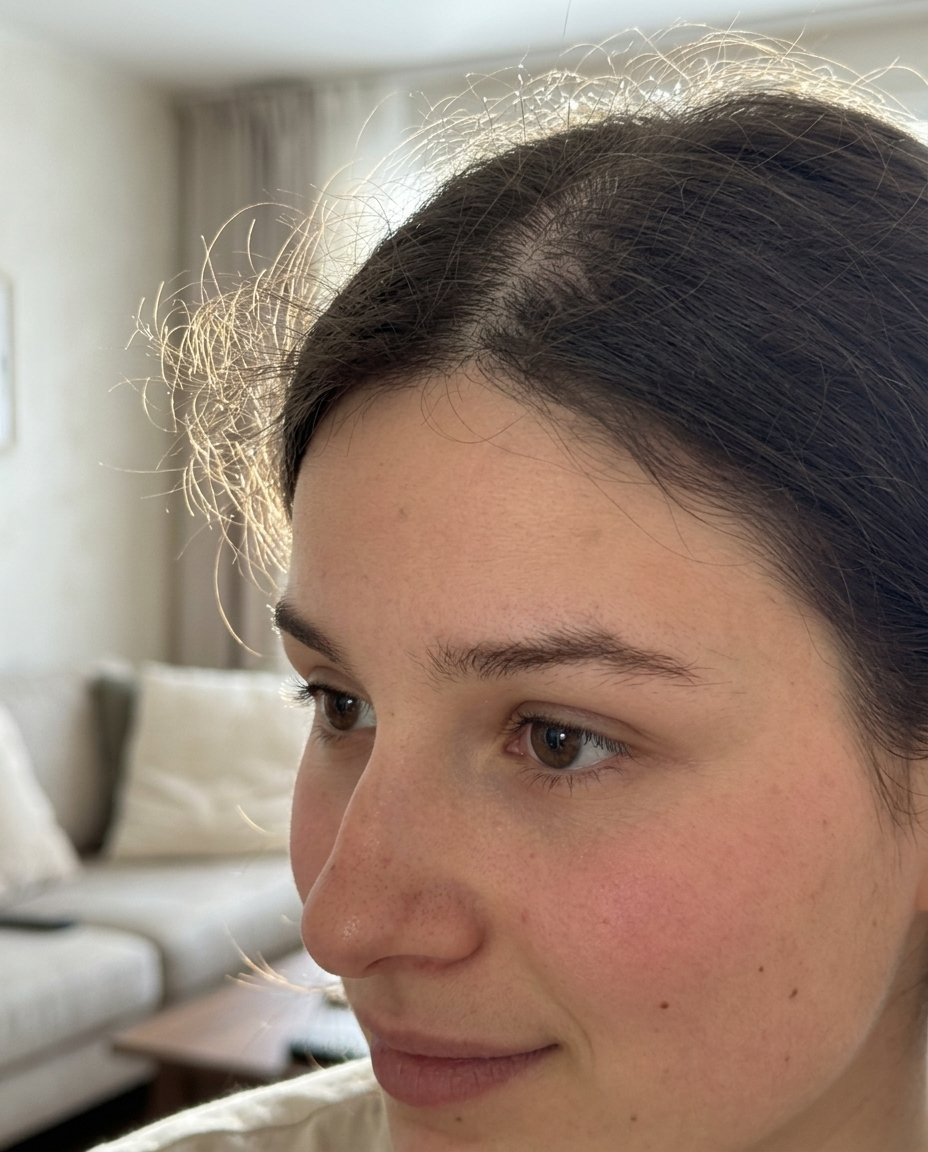
Months 6 to 9: the slowdown. The shedding tapers. It doesn’t stop on a Tuesday; it just gradually becomes less alarming until one day you notice you haven’t thought about the drain in a week. Meanwhile, the temples that receded start sprouting the famous baby-hair halo: short, fuzzy regrowth that sticks straight up and ignores every styling product invented. Annoying? Deeply. But it’s the single best sign in this whole timeline, because it means the follicles are back at work. (Those little hairs deserve their own survival guide, and they have one: Baby Hairs 101: Living With the Postpartum Regrowth Halo.)
Months 9 to 12: recovery. Density visibly returns. The halo grows into an awkward layer of mini-bangs and flyaways. By the first birthday, most of us are back to something that reads as our normal hair, even if the new growth is still catching up in length.
Months 12 to 18: the blend. The regrowth finally gets long enough to lie down and blend in. This is the true end of the story, and it’s why photos from your baby’s second year look like “you” again.
The plot twist: the weaning shed
Here’s the one that catches people who thought they were done. Weaning, especially fast weaning, shifts hormones again, and some women get a second, smaller shedding wave two to four months after stopping or significantly reducing nursing. Same mechanism, same rules, usually milder and shorter than the first round. If you shed at month four, recovered, weaned at month fourteen, and started shedding again at month sixteen: that’s not a mystery and not a red flag. It’s the same play with a shorter second act.
Similarly, getting pregnant again resets the whole clock. Estrogen goes back up, shedding pauses, and the bill comes due again a few months after the next delivery. (Nora is currently my only clock, but I’ve made peace with the rerun if there’s a sequel.)
When the timeline being “off” actually matters
The schedule above has normal wiggle room; a few weeks either direction means nothing. But some departures from it are worth acting on rather than waiting on:
- Shedding that starts way outside the window, like heavy loss beginning at month eight or nine with no weaning event to explain it. Something else may be driving it (thyroid and iron are the usual suspects after pregnancy), and that’s checkable with simple bloodwork.
- A peak that never ends. If month seven or eight looks identical to month four, with no taper at all, don’t keep white-knuckling it.
- Density that never returns. If the first birthday comes and goes and your part is still wider and your ponytail still thinner, the wait-it-out advice has expired. That exact situation has its own guide: It’s Been a Year and My Hair Never Came Back: Now What?
- Anything that isn’t diffuse shedding: smooth bald patches, or a scalp that itches, burns, or hurts. Different conditions, different timelines, and worth an actual appointment rather than a schedule.
None of those mean disaster. They just mean the “normal timeline” post you’re reading stops being the right map, and a fifteen-minute derm visit becomes the better use of your energy than another month of counting hairs.
The short version, one-handed edition
- The 3-month delay is real: hairs decided to shed at delivery and take about three months to actually let go.
- Starts around month 3, peaks months 4 to 6, tapers by month 9, density back by month 12, fully blended by 18.
- The spiky halo around month 6 to 9 is regrowth, not new damage.
- Weaning can trigger a smaller second shed a few months later. Same rules, shorter run.
- Off-schedule versions (late start, no taper, no recovery by 12 months, patches, scalp symptoms) are worth bloodwork and a derm visit, not more waiting.
The whole thing is a season. It has a start date, a worst week, and an end, and you’re somewhere on that map right now, closer to the end of it than the drain would have you believe.
You’re still in there. — Kelsey
Leave a Reply