If you’re like me, “just go see a dermatologist” lands somewhere between “just sleep when the baby sleeps” and “just make time for yourself.” Technically correct. Practically laughable. Who is watching Nora during this appointment? What do I even say when I get there? What if they tell me it’s nothing and I feel silly?
So this is the post that turns “you should probably see someone” into an actual plan: when it’s genuinely worth booking, what happens in the room, and how to walk in prepared enough that one visit gets you real answers.
When to book (and when you can skip it)
You can skip the appointment, at least for now, if: you’re inside the first year postpartum, the shedding started around month three, it’s coming out evenly everywhere, and it’s clearly slowing down. That’s textbook postpartum shedding, it resolves on its own, and I wrote the full no-panic guide here: Why Is My Hair Falling Out After the Baby?
Book the appointment if any of these are true:
- It’s been more than 12 months and your density never came back. The wait-it-out window has closed and you deserve actual information. (This situation gets its own full guide: It’s Been a Year and My Hair Never Came Back.)
- Your part keeps getting wider or your crown keeps getting thinner, month over month, especially if thinning runs in your family.
- You have smooth, round, completely bald patches. That’s a different condition (alopecia areata) with its own treatments, and sooner is better.
- Your scalp itself has symptoms: burning, pain, intense itching, redness, scaling, or pimple-like bumps around follicles. Some scalp conditions can scar follicles permanently, so this one is not a “wait and see.” Book promptly.
- The hair loss comes with a body that feels off: exhaustion beyond normal new-mom tired, feeling cold all the time, unexplained weight changes, heart palpitations, or very heavy periods. Thyroid problems and iron deficiency both cause hair loss and both are extremely common after pregnancy. Postpartum thyroiditis in particular flies under the radar because its symptoms get written off as “just having a baby.”
- The not-knowing is eating you. Honestly? This counts. Anxiety about your hair is a real cost, and one appointment is cheaper than a year of 2 a.m. googling.
Dermatologist or OB or primary care?
A dermatologist is the specialist for hair and scalp, and the right destination for pattern thinning, patches, or scalp symptoms. But if getting in takes three months (in a lot of cities it does), don’t stall: your OB or primary care doctor can run the blood panel side of this at your next visit and refer you onward. Ben’s move when I kept “meaning to book it” was putting the dermatologist’s number in my phone under the name CALL HER, KELSEY. Do whatever version of that works for you.
One practical tip: when you call, say the words “hair loss” specifically. Some derm offices triage cosmetic-sounding concerns to a longer wait; a medical concern phrased as one (“postpartum hair loss that hasn’t recovered,” “scalp pain with shedding”) is usually scheduled sooner.
What actually happens in the room
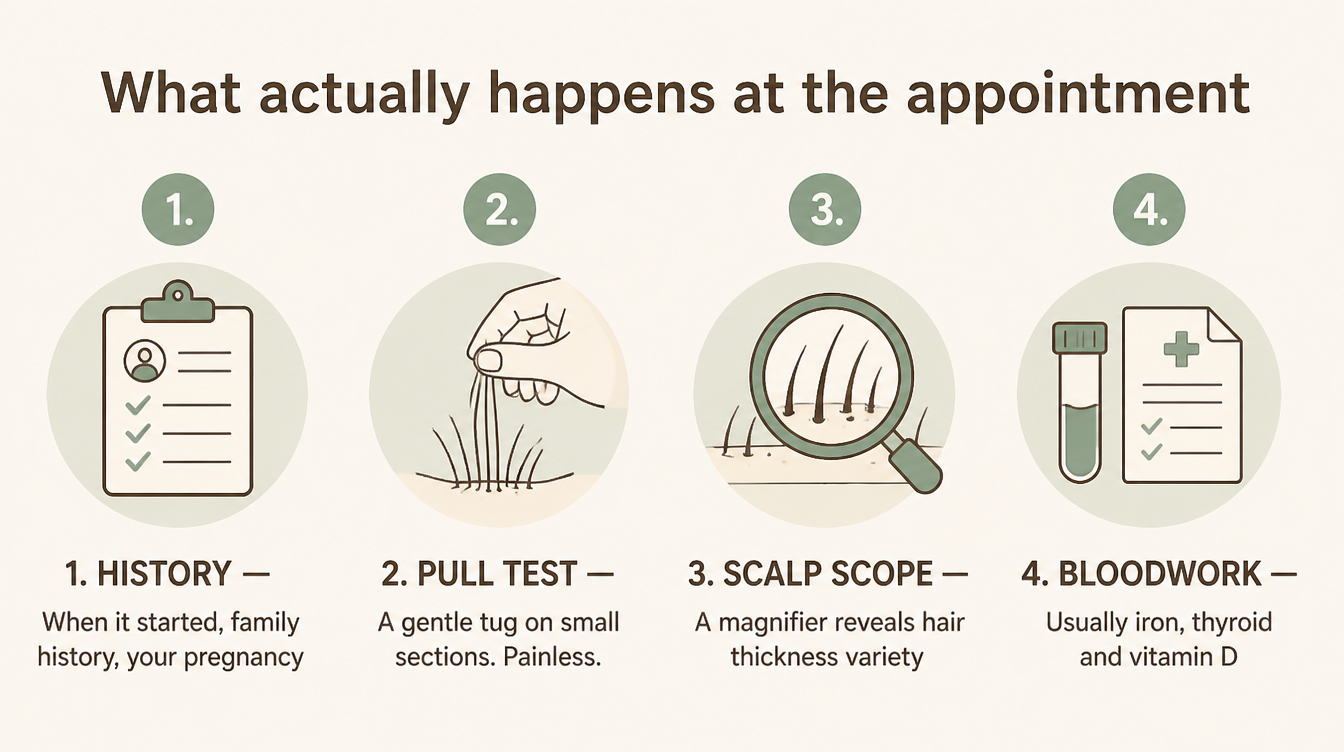
Nobody told me this part, so I’m telling you. It’s a short, painless, non-scary appointment:
- History. When it started, how it’s changed, your pregnancy and delivery, medications, diet, family hair history. This conversation is half the diagnosis, which is why the prep below matters.
- The pull test. The doctor gently tugs small sections of hair to see how many strands release. Slightly weird, totally painless.
- Trichoscopy. They look at your scalp with a magnifier (a dermatoscope) to see follicle health, hair shaft thickness, and the pattern of any miniaturization. This is often the moment shedding and pattern thinning get told apart.
- Bloodwork, usually. A standard hair-loss panel checks things like ferritin (iron stores), thyroid function, and vitamin D. If something’s low, congratulations, you may have just found a very fixable answer.
- Rarely, a small scalp biopsy, only if something unusual needs confirming. Most of us never get near this step.
That’s it. You’ll likely leave with either a diagnosis or a blood draw slip, and either one is progress.
How to prep so one visit is enough
Appointments are short. Walk in with this and you’ll get more out of fifteen minutes than most people get out of three visits:
- Photos. Your part and crown today, plus the oldest clear photo of your part you can find from before pregnancy. Before-and-after beats description every time.
- A one-line timeline. “Baby born [month]. Shedding started [month]. Peaked [month]. As of now, [still shedding / stopped but thin / part widening].”
- Family history. Any thinning in your mom, grandmothers, aunts, sisters. Either side of the family counts.
- Your list: medications, supplements, whether you’re nursing, whether you’re planning another pregnancy. These change which treatments are on the table, so say them up front.
- The hair tie test count, if you have it: how many times you wrap your ponytail now versus before. Silly-sounding, genuinely useful data.

Questions worth asking before you leave
- “Is this telogen effluvium, pattern hair loss, or something else, and how sure are we?”
- “Can we run ferritin, thyroid, and vitamin D?”
- “If it’s pattern thinning: which options are compatible with nursing or another pregnancy, and which aren’t?”
- “What should I expect to see in six months if we do nothing versus if we treat?”
- “When should I come back, and what change would mean I should come back sooner?”
And one thing not to accept: a shrug and “that’s just what happens after babies.” Sometimes it is. But that answer should come after the exam and the bloodwork, not instead of them. You’re allowed to ask for the workup.
The short version, one-handed edition
- Skip the visit (for now) if you’re under a year postpartum with even, slowing, textbook shedding.
- Book it for: no recovery past 12 months, a widening part or thinning crown, bald patches, any scalp pain/itching/scaling (book that one fast), or hair loss plus feeling generally off (thyroid and iron are common postpartum culprits).
- The appointment is painless: history, pull test, scalp scope, usually bloodwork.
- Bring photos, a one-line timeline, family history, and your nursing/pregnancy plans.
- Don’t accept “that’s just motherhood” without the workup.
Booking the appointment isn’t vanity and it isn’t overreacting. It’s fifteen minutes of real information in a season of life that runs almost entirely on guesswork.
You’re still in there. — Kelsey
Leave a Reply