If you’re like me, you spent months praying for regrowth, got it, and then immediately wanted to file a complaint.
Because nobody tells you what regrowth actually looks like. It’s not your hair quietly returning to its former glory. It’s a halo of two-inch fuzz standing straight up around your hairline like you rubbed a balloon on your head, spiky little antennae at your temples, and a crown that looks permanently backlit. In every photo. For months.
Ben once asked, very gently, if I’d “done something different” with my hair. I had not. The hair was doing it by itself.
So this is the survival guide for the halo phase: what those hairs are, how to confirm they’re the good kind, how to live with them, and the things I tried so you don’t have to.
What baby hairs actually are (and why to be glad about them)
Quick recap of the mechanics (the full story is in the main shedding guide): after the big postpartum shed, your follicles cycle back into the growing phase and start over from zero. Those wispy new hairs are brand-new growth on the follicles you were worried had quit.
Which means the halo, as ridiculous as it looks, is the receipt. It’s visible proof the shedding chapter is closing. On the standard timeline it usually shows up somewhere in months six to nine, right as the shedding tapers, and the awkwardness peaks precisely when you were hoping to feel normal again. The comedy writes itself.

Why they stick straight up
Three boring reasons with one silly result. New hairs are short, and short hair doesn’t have enough weight to lie down. They taper to a fine point instead of ending bluntly, so they’re extra flexible and extra static-prone. And new growth sometimes comes in with slightly different texture than the rest of your hair (finer, curlier, occasionally more silver; postpartum regrowth loves a surprise). Put those together and you get hair that physically cannot join the rest of the class yet. It’s not damage and it’s not a styling failure. It’s just physics with a two-inch hair.
The important check: regrowth or breakage?
This is the one genuinely useful skill in this post. Short hairs around the hairline can be new growth (good) or snapped hairs (fixable, different cause). Here’s how to tell:
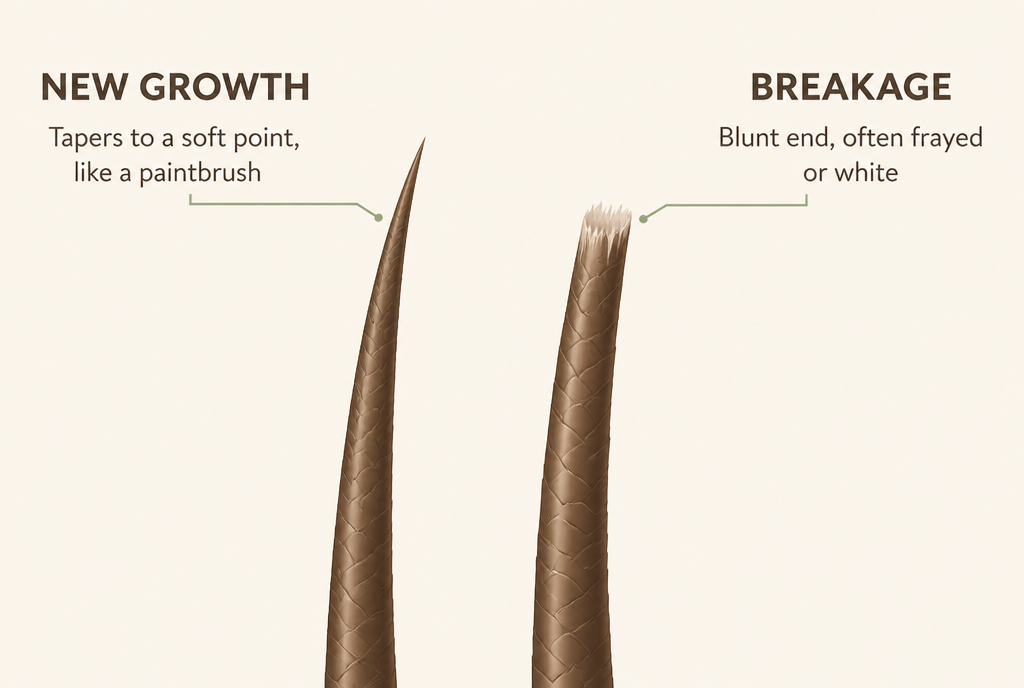
- Look at the ends. Catch a few of the short hairs and look closely, good light, maybe your phone camera zoomed in. Regrowth tapers to a soft, fine point, like the tip of a paintbrush. Breakage ends bluntly, like it was cut, and often looks frayed or white at the tip.
- Look at the pattern. Regrowth shows up as a fairly even halo along the hairline and temples, all roughly similar lengths within a zone. Breakage clusters where the stress is: the crown line where your claw clip bites, the spot your ponytail sits, wherever the flat iron lingers.
- Look at the timeline. Regrowth arrives on schedule after a shed. Breakage arrives after a new habit: tighter styles, more heat, bleach, a rough brush.
Mostly tapered tips in an even halo: congratulations, it’s regrowth, proceed to the styling section. Mostly blunt ends clustered at stress points: ease up on tension and heat and the problem stops being created. And one more distinction while we’re here: baby hairs coming in is the opposite of a problem, but if instead of a halo you’re seeing your part get wider or more scalp at your crown as the months pass, that’s a different conversation, and I wrote it here: It’s Been a Year and My Hair Never Came Back.
Living with the halo: what actually works
The toothbrush trick. A clean soft toothbrush (or a tiny spoolie brush) misted with a little hairspray or touched with a dab of light balm, brushed gently over the flyaways in the direction you want them to go. Sixty seconds, works better than anything sold specifically for this purpose, costs nothing. This is the single tip I’d keep if I could only keep one.
Work with gravity, not against it. A slightly deeper side part or loose curtain-y pieces in front let the halo blend into intentional-looking texture. Slicked-back styles are the halo’s natural enemy; the tighter the style, the more the two-inch rebels stand out against it.
Soft accessories. Silk or satin scrunchies, claw clips instead of tight elastics, a satin pillowcase if you’re feeling fancy. Not because they speed anything up (nothing does), but because the one thing you can do for baby hairs is not snap them while they grow. They have to survive a year to reach blending length; make it easy on them.
Embrace the wet-look edge brush… sparingly. Gel and edge control can tame the front for an event, but heavy daily product on fine new growth mostly buys you crunchy, visible baby hairs instead of fluffy ones. Save it for photos.
Lower the stakes. Genuinely: most people do not notice the halo the way you do. You’re viewing your hairline in macro mode several times a day. Everyone else is looking at your whole face, which, reminder, is attached to a person who kept a human alive this year.
What not to bother with
Trimming them “to help them grow.” Cutting the tips doesn’t speed growth (growth happens at the follicle, not the end), and it turns soft tapered tips into blunt stubble that sticks up even more aggressively. Leave them alone.
Plucking or waxing the “messy” ones. Please no. Those are your recovered follicles doing exactly what you wanted. Traumatizing them from the outside is the only way to actually lose them.
Growth serums promising to fast-forward this phase. The halo resolves by getting longer, and hair grows about half an inch a month, serum or no serum. Anything claiming to rush a healthy follicle is selling you the calendar. (You know my policy: we keep our money.)
The short version, one-handed edition
- The halo is regrowth, which means it’s the shedding story ending. It shows up around months 6 to 9 and blends by 12 to 18.
- Tapered soft tips in an even halo = new growth. Blunt frayed ends clustered at stress points = breakage; fix the tension and heat.
- Best tool: a soft toothbrush with a mist of hairspray. Best styles: looser ones that let the fuzz read as texture.
- Don’t trim, pluck, or wax them, and skip anything promising to speed them up. They just need time and to not be snapped.
- No halo at all, and a part that keeps widening instead? Different situation; start with the “never came back” guide.
The fuzz is temporary. The follicles are back. And every ridiculous, staticky, backlit antenna on your head is a small flag your body planted that says: rebuilding.
You’re still in there. — Kelsey
Leave a Reply