If you’re like me, somewhere around peak shedding you got scared of your own shower. Washing meant watching it happen, so maybe you washed less. Brushing meant a full brush, so maybe you brushed less. And a small superstitious voice suggested that if you just handled your hair less, maybe you’d lose less of it.
I have good news and a small correction. The good news: there’s a real, sensible way to care for hair during the shedding months, and it costs almost nothing. The correction: the hairs in your drain were leaving no matter what you did, and the goal of gentle care isn’t to stop the shed. It can’t. The goal is to protect the hair that’s staying, and the new hair coming in, from the one kind of loss you actually control: breakage.
Two different problems. Shedding is the follicle releasing the whole hair, root and all (look for the tiny white bulb at the end). Breakage is a hair snapping partway down because something stressed it. You can’t out-shampoo hormones, but you can absolutely stop snapping hairs. Here’s the whole playbook.
Washing: yes, keep doing it
The scary shower is an illusion worth dismantling. Hairs that have finished their cycle sit loosely in the follicle until something dislodges them; washing doesn’t cause the loss, it just collects several days of already-detached hairs into one dramatic drain moment. Wash less, and the same hairs simply come out in your brush, on your pillow, and in your baby’s fist instead, while your scalp gets oilier and itchier underneath.
So wash on whatever schedule keeps your scalp comfortable, with whatever shampoo you like. Genuinely: for shedding, the shampoo does not matter, and “hair loss shampoos” are mostly marketing aimed at this exact scared moment. A shampoo touches your hair for ninety seconds and rinses down the drain; it is not reaching into your follicles and changing hormonal arithmetic. Buy the one that smells nice and costs normal money. What does help: massage the scalp with fingertips, not nails, and be a little patient with conditioner, because detangling in the shower with slippery conditioner is the gentlest detangling there is.
Detangling: the order of operations
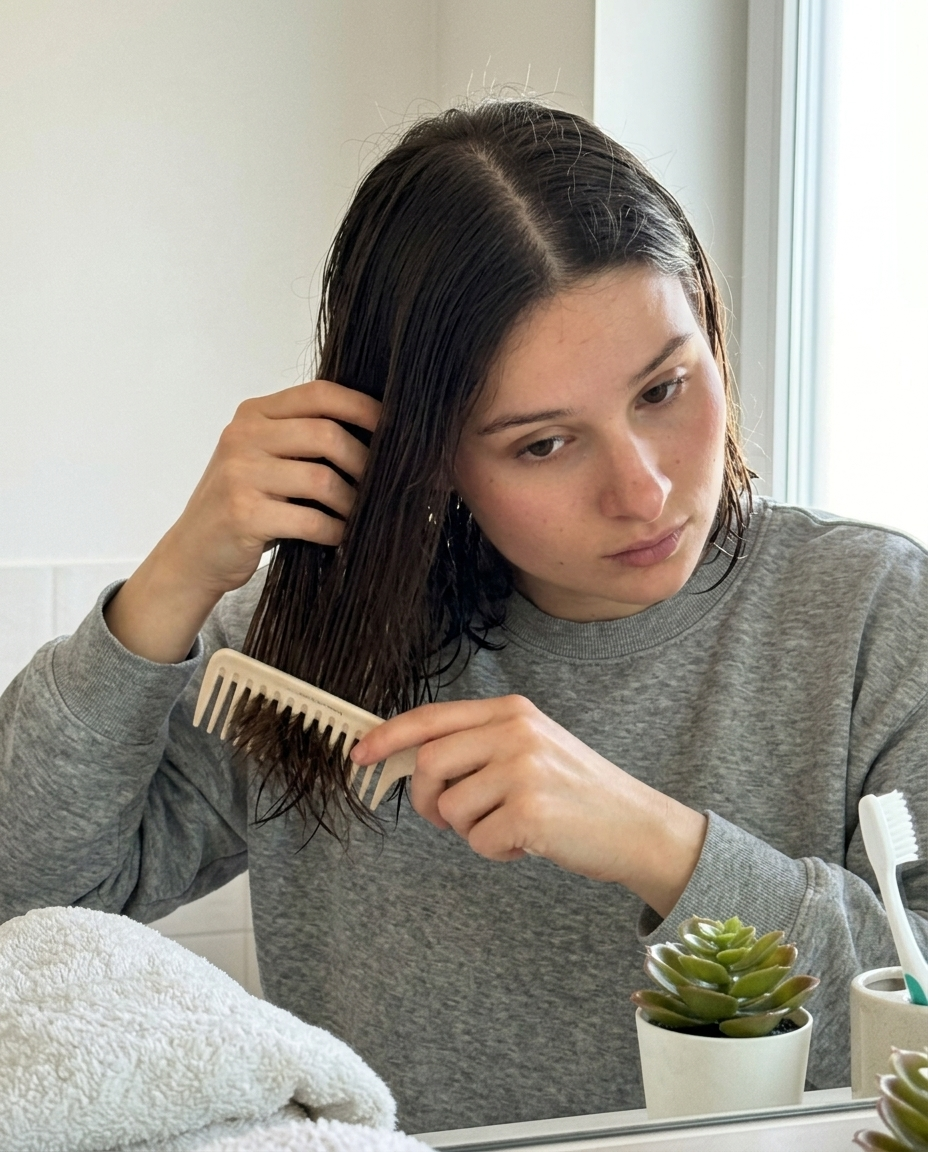
Most breakage happens right here, so this is the highest-value habit change in this post. Wet hair stretches and snaps more easily than dry hair, so how you get knots out matters:
- Start from the ends, work up. Detangling from the roots drags every knot down the full length of the hair and rips through all of them at once. Ends first, then middle, then roots.
- Wide-tooth comb or a flexible-bristle brush on wet hair; save fine-tooth tools for dry, styled moments.
- When you hit a knot, hold the hair above it with your other hand so the tension pulls against your grip instead of your follicle. Old trick, works forever.
- Blot, don’t rough-dry. The aggressive towel scrub roughs up the cuticle and snaps fine hairs. Squeeze water out with the towel (or an old cotton t-shirt, which is smoother) and let it be.
Styles: loose is the whole strategy
Tension is cumulative and it concentrates at the hairline and temples, which are exactly the fragile, regrowing zones right now. The mom bun lives at the scene of the crime. You don’t need to abandon it; you need to lower its stakes: a soft scrunchie or claw clip instead of a tight elastic, the bun sitting a little looser and a little lower, and the part or ponytail position moved around every few days so the stress never lives in one spot. Skip anything that pulls at the edges while the baby-hair halo is coming in; those new hairs are the finest, snappiest hairs on your head and they need a year of not being yanked to reach blending length.
Also filed under tension: small humans. Babies grab hair with shocking grip strength and zero remorse. Hair worn up and loose, or a soft headband, saves both your hairline and the prying-open-of-tiny-fists ritual. (I say this as someone whose daughter treated my hair as climbing equipment for an entire year.)

Heat and chemistry: a season of less
Heat doesn’t cause shedding either, but it’s the top manufacturer of breakage, and during a shed your hair has less margin for it. The move isn’t zero heat forever; it’s a season of less: air-dry when life allows, keep the dryer on medium instead of scorching, use a heat protectant when you do style, and let the flat iron rest more weeks than it works. Same logic for bleach and tight chemical treatments; if a big color change can wait a few months, your postpartum hair will absorb it much more gracefully than your peak-shed hair will.
The sleep upgrade, if you want one: a satin or silk pillowcase, or a loose braid at night. Less friction, fewer snapped baby hairs, and it’s the rare hair purchase that’s cheap, low-stakes, and actually does what it claims.
What all this buys you (and what it doesn’t)
Fair expectations, as always. Gentle care will not shorten the shed by one day; the timeline is hormonal and it runs its course. What gentle care does is make sure that when the shed ends, everything that stayed is intact, and everything new gets to grow in unbroken. The difference between “recovered” and “recovered but frizzled with snapped bits” at month twelve is mostly decided by these habits at month five.
And the standing reminder: this post assumes normal shedding. If your hair is coming out with scalp pain, in patches, or your part keeps widening long after the shed should have tapered, gentle handling isn’t the answer to that; the main guide covers how to tell the difference and where to go next.
The short version, one-handed edition
- You can’t wash, brush, or product your way out of hormonal shedding. Gentle care exists to prevent breakage, the loss you do control.
- Keep washing normally; the drain collects hairs that already let go. Skip the “hair loss shampoo” aisle entirely.
- Detangle ends-first on conditioner-slippery hair, hold above knots, blot instead of scrubbing.
- Loose, low, soft, and moved-around beats tight and fixed. Guard the hairline; it’s regrowing.
- Run a low-heat, no-drastic-chemistry season. Satin pillowcase optional but pleasant.
Your hair is doing something hard right now, and so are you. Neither of you needs a fourteen-step routine. You need low tension, low heat, and time, and you’re allowed to keep things exactly that simple.
You’re still in there. — Kelsey
Leave a Reply